Logistics
Warehousing & Fulfillment
Transportation
E-commerce
E-commerce Fulfillment Services
Lease & Maintenance
Semi Trucks
Supply Chain Technology
Fleet Management Technology
Logistics
E-commerce
Lease & Maintenance
Buy Used Trucks
In a fast-paced global economy, supply chain efficiency can make or break a business. As companies strive to meet evolving consumer demands, the logistics industry is transforming to provide more streamlined, effective solutions.
One such innovation is the Ryder Port2Door™, a fully integrated logistics approach that reshapes the way goods are transported from their point of origin to their final destination.
Picture this scenario: You start your day only to find out that one of your trucks has broken down on the highway. The driver is unharmed, but the delivery will be delayed by eight hours. Retailers are already reaching out. Store shelves are empty. Customers are left without the products they expect. Or think about walking into your warehouse, expecting a full team, only to find several employees absent. Orders begin to accumulate rapidly. You had a plan, but now you're already behind before the day has even begun. Perhaps your business is expanding, but you're running out of space to store additional inventory, and you lack the trucks and drivers to handle increased deliveries. These aren't hypothetical situations; they're challenges you likely face regularly: monthly, weekly, or even daily.
On top of these internal issues, your supply chain is constantly under pressure from external factors, including labor shortages, infrastructure limitations, unpredictable weather, demand surges, and geopolitical uncertainties.
You also have to navigate volatile freight cycles, fragmented technology systems, port complexities, cross-border hurdles, and escalating costs.
Despite these challenges, your customers are focused on one thing: receiving their products on time and in full. If your supply chain falters, they won't hesitate to turn to a competitor.
This is precisely why Ryder developed its Port2Door supply chain solution, keeping all these challenges and your needs at the forefront.
That’s why, in this article, we’ll explore the port-to-door concept, highlight the pitfalls of fragmented logistics, and demonstrate how Ryder's integrated approach delivers superior outcomes.
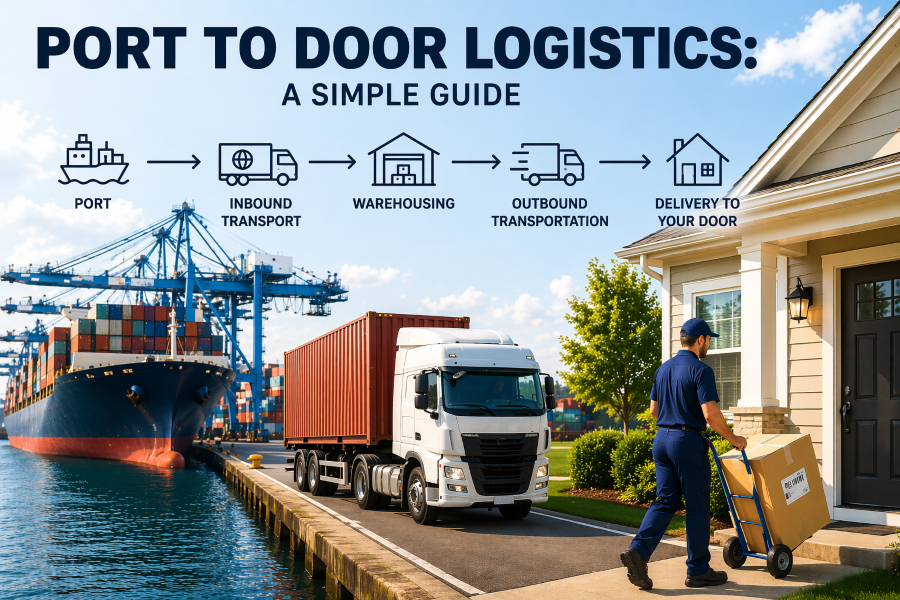
The term "port-to-door" refers to a comprehensive logistics solution that manages the entire journey of goods from the port of entry to the final delivery point.
Unlike traditional models that involve multiple vendors and numerous handoffs, Ryder Port2Door™ is a unified approach that eliminates these inefficiencies.
By integrating all stages of the supply chain, from customs clearance and warehousing to transportation and final delivery, port-to-door ensures a smooth and continuous flow of goods.
This approach not only simplifies logistics, but also enhances control and visibility throughout the supply chain.
Key aspects of port-to-door:
This approach offers a streamlined process, eliminating the need for importers to navigate complex inland logistics or handle customs procedures independently.
Once goods arrive at the port, they are seamlessly transferred to warehouses or distribution centers, where they are stored and prepared for final delivery. This integrated process reduces the risk of delays and errors, ensuring that products reach their destination on time and in optimal condition.
Logistics fragmentation happens when separate vendors manage different stages of the supply chain. This multi-vendor model often leads to a lack of coordination, increased risk of errors, and reduced visibility.
Each handoff between vendors introduces potential delays and miscommunications, resulting in higher costs and compromised service quality.
In a fragmented supply chain, businesses struggle to maintain a cohesive view of their supply chain, making it difficult to respond swiftly to disruptions or changes in demand. This is where the port-to-door model shines.
Fragmented logistics can also lead to a lack of accountability. When multiple vendors are involved, it becomes challenging to pinpoint the source of a problem or delay. This can result in finger-pointing and a lack of resolution, further exacerbating the issue.
Additionally, fragmented systems often require businesses to invest in multiple technologies and platforms to manage different parts of the supply chain, increasing complexity and costs.
By contrast, a port-to-door approach consolidates these functions under a single provider, streamlining operations and enhancing transparency and accountability.
The urgency for adopting a port-to-door approach has never been greater. With globalization and e-commerce driving unprecedented demand for fast and reliable delivery, businesses can no longer afford the inefficiencies of fragmented logistics.
Consumers expect quick and seamless service, and any delay or disruption often leads to lost sales and damaged reputations. Recent global supply chain disruptions have highlighted the vulnerabilities of traditional logistics models.
By adopting a port-to-door strategy, companies can enhance their resilience, agility, and competitiveness in an increasingly complex market.
Consider the COVID-19 pandemic. It further underscored the importance of a robust and flexible supply chain. As businesses faced unprecedented disruptions, those with integrated logistics solutions were better equipped to adapt and maintain operations.
The ability to quickly pivot and respond to changing circumstances is crucial in today's volatile environment. A port-to-door approach provides the agility needed to navigate these challenges, ensuring that businesses can continue to meet customer expectations and maintain a competitive edge.
The port-to-door model offers key benefits to address the shortcomings of fragmented logistics. Firstly, it significantly improves speed by reducing handoffs and streamlining processes.
With a single provider managing the entire supply chain, goods move more swiftly from port to destination. This reduction in transit time not only enhances customer satisfaction but also allows businesses to respond more quickly to market demands.
Secondly, the port-to-door model reduces costs by minimizing inefficiencies and leveraging economies of scale. An integrated approach allows for better resource utilization and cost management.
By consolidating logistics functions with one provider, businesses can negotiate better rates and reduce overhead associated with managing multiple vendors. This cost-effectiveness translates into improved profitability and a stronger bottom line.
Port-to-door offers enhanced visibility with real-time insights. With access to comprehensive data and analytics, businesses can identify trends, optimize inventory levels, and anticipate potential disruptions.
Enhanced visibility also facilitates better communication and collaboration with stakeholders, ensuring that everyone is aligned and informed throughout the supply chain.
Our state-of-the-art digital platforms RyderShare™, RyderShip™, RyderView™, and RyderGyde™ provide you with enhanced control and visibility.
You can monitor your orders, fleet, inventory, and routes in real-time, all from a single, integrated platform that connects seamlessly with your network of suppliers, vendors, and customers.
This technology integration enhances efficiency and empowers you to make informed decisions and respond quickly to changes.
You can plan more effectively and manage exceptions as they arise.
Our dedicated team supports this: From warehouse managers and data scientists to skilled truck drivers, technicians, and supply chain engineers, our people become an extension of your brand.
They ensure operations run smoothly, address issues before they escalate, and deliver on your promises to your customers.
Ryder Port2Door™ exemplifies the power of integration in logistics. As a fully integrated logistics provider, Ryder manages every aspect of the supply chain to ensure a seamless flow of goods from port to door.
Ryder's comprehensive approach includes managing customs clearance, warehousing, transportation, and final delivery. By centralizing these functions, Ryder eliminates the inefficiencies and risks associated with multiple handoffs.
Our expertise in navigating complex logistics challenges ensures that goods are delivered on time and in optimal condition. Furthermore, Ryder's commitment to continuous improvement and innovation ensures that their solutions continually evolve to meet the market's changing needs.
Your business is one of a kind, and your supply chain should reflect that uniqueness. You require a flexible, tailored operation that can expand alongside your business.
Whether you need a comprehensive solution or specific services like warehousing, e-commerce fulfillment, last-mile delivery, or contract packaging, we have you covered.
Perhaps you're looking for a more efficient transportation strategy, whether it's for full truckload, less-than-truckload (LTL), truck leasing and maintenance, intermodal, drayage, freight brokerage, transportation management, or a dedicated transportation solution.
We adapt to your current needs and scale your operations as your business grows. We collaborate with you to integrate the right combination of technology, automation, skilled personnel, and physical infrastructure, such as vehicles, warehouses, and assets, to meet your specific requirements.
Drawing from our extensive experience across various industries, Ryder brings innovative ideas and best practices from one sector to another, optimizing your operations for maximum efficiency.
In an era where efficiency and agility are paramount, the port-to-door concept represents a significant advancement in logistics.
By eliminating fragmentation and integrating all stages of the supply chain, this approach delivers faster, more cost-effective, and transparent solutions. Ryder's leadership in port-to-door logistics, bolstered by innovative technology, sets us apart from fragmented competitors.
Contact us to explore Ryder Port2Door™ and connect your supply chain with a provider that truly understands the value of integration.