Logistics
Warehousing & Fulfillment
Transportation
E-commerce
E-commerce Fulfillment Services
Lease & Maintenance
Semi Trucks
Supply Chain Technology
Fleet Management Technology
Logistics
E-commerce
Lease & Maintenance
Buy Used Trucks

Key Takeaways:
In an era of increasing volatility, traditional supply chain planning methods are increasingly being outpaced by the complexities and speed of modern predictive logistics.
Historically, supply chain leaders have relied on planning tools built on historical averages, static monthly or quarterly forecasts, and limited capabilities to respond to volatility.
While these methods were effective in a more predictable era, today’s supply chain planning demands a more dynamic approach.
Predictive analytics in supply chain is the natural evolution in planning, transforming how organizations plan, operate, and compete.
For decades, supply chain planning has been a backward-looking exercise, heavily reliant on spreadsheets and periodic updates. These traditional methods are reactive, often struggling to keep pace with the fast-moving, complex, and unpredictable nature of modern, data-driven supply chains.
As supply chains have become faster and more intricate, the limitations of static planning models have become increasingly apparent. Predictive analytics offers a forward-looking, continuous, data-rich, and proactive approach to planning.
Traditional planning models were designed for a time when supply chains were relatively stable and predictable. Companies could rely on historical data to forecast demand and plan their operations.
Globalization, e-commerce, and increased customer expectations have introduced new levels of complexity. Supply chains now operate in an environment where disruptions can occur at any time, driven by geopolitical events, natural disasters, or sudden shifts in consumer behavior.
The limitations of traditional planning are evident: static forecasts, typically updated monthly or quarterly, simply cannot keep up with the rapid pace of change. This lag in information can lead to inefficiencies, such as overstocking or stockouts, and ultimately impact a company's bottom line.
Additionally, traditional planning often relies on siloed data, with warehousing and fleet information existing in separate systems.
That’s why predictive analytics is changing how organizations plan, operate, and compete in real time
Predictive analytics in the supply chain represents a significant shift from traditional planning. It combines big data, statistical modeling, and various mathematical techniques. Rather than relying solely on historical data and periodic updates traditional analytics emphasizes, predictive analytics is oriented toward the future.
Businesses are using predictive analytics to analyze past achievements and setbacks and to predict future events by understanding and manipulating controllable variables.
Real-time operational data, historical trends, external signals such as traffic, weather, and demand shifts, and machine learning to forecast outcomes before they happen.
This approach means anticipating changes and making informed decisions proactively, rather than reacting to events after they occur.
Predictive analytics is fundamentally different because it is forward-looking and continuous. It uses advanced algorithms and machine learning models to analyze vast amounts of data from various sources.
By incorporating real-time data, predictive analytics can provide insights not only into current conditions but also into future scenarios. Organizations can identify potential risks and opportunities before they materialize.
For example, predictive analytics in supply chains can analyze weather patterns and traffic data to anticipate transportation delays.
It can also monitor social media and news sources to detect emerging trends that may impact demand. By integrating these external signals with internal operational data, organizations can create a comprehensive view of their supply chain and make proactive decisions.
Several key factors highlight why traditional planning models are no longer enough:
Traditional planning updates cannot keep pace with daily disruptions. In today’s environment, decisions need to be made in hours, not weeks.
The speed at which supply chains operate today is unprecedented. E-commerce and omnichannel has accelerated business. Consumers and businesses expect faster delivery times and greater flexibility.
This requires supply chain planning to be agile and responsive. Predictive analytics addresses this challenge by providing real-time insights that enable organizations to respond to disruptions as they occur.
The proliferation of SKUs, regional demand swings, and capacity constraints makes it difficult for static forecasts to remain accurate and relevant.
Modern supply chains exhibit significant variability. The introduction of new products, changes in consumer preferences, and fluctuations in demand can all impact supply chain operations. Static forecasts, which are based on historical data, struggle to account for these dynamic factors.
Predictive analytics, on the other hand, continuously updates forecasts using real-time data, enabling organizations to adapt to changing conditions and optimize operations.
When transportation, warehousing, and fleet data exist in silos, it limits end-to-end visibility and effective decision-making.
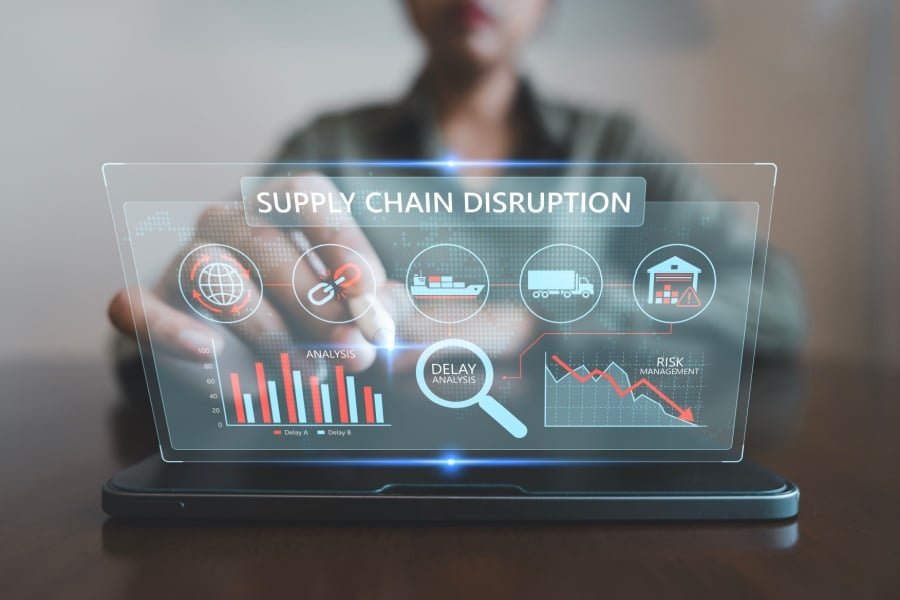
As McKinsey points out, a typical company might lose almost 50% of its annual profit over 10 years due to a single, extended, and severe supply chain disruption.
This can result from various issues, such as inefficient vehicle and shipment routing, as well as inaccurate data and inventory tracking that do not adapt to swiftly changing conditions.
One of the biggest challenges in supply chain planning is the lack of integration between different systems. This siloed approach creates blind spots, making it difficult for organizations to gain a comprehensive view of their supply chain operations.
Predictive analytics addresses this issue by integrating data from various sources, providing end-to-end visibility and enabling more informed decision-making.
Predictive analytics is not just a feature; it’s a comprehensive solution that addresses the shortcomings of traditional planning:
Predictive models update in real time as conditions change, allowing plans to evolve at the same pace. Ryder uses predictive analytics across transportation and warehousing operations to continuously optimize routing, capacity utilization, and service performance.
Continuous optimization is a quantum leap for supply chain management. By continuously analyzing data and updating models, organizations can ensure their operations remain aligned with current conditions.
This leads to more efficient resource use, reduced costs, and improved service levels. Here at Ryder, our use of predictive analytics in routing and capacity planning demonstrates how continuous optimization can drive significant improvements in supply chain performance.
Predictive analytics in the supply chain enables organizations to identify risks before they become disruptions and take action earlier.
Platforms like RyderShare™ and Ryder’s transportation management solutions provide real-time insights that facilitate proactive responses to delays, dwell time, and capacity constraints.
Proactive decision-making is essential in today’s and tomorrow’s fast-paced supply chain planning environment. By identifying potential risks early, organizations can take preventive measures to mitigate their impact.
This reduces the likelihood of disruptions and ensures that operations run smoothly. Ryder’s technology platforms, which provide real-time insights into transportation and logistics operations, empower organizations to make proactive decisions and maintain high service levels.
Planning decisions across fleet, warehouse, and last-mile operations must be aligned.
Predictive analytics enables cross-functional coordination, and Ryder’s connected technology ecosystem integrates connected fleet telematics, TMS, and warehouse data to support end-to-end planning and execution.
Connected planning is critical for achieving supply chain efficiency. By aligning decisions across different functions, organizations can ensure that all parts of the supply chain work together seamlessly.
Ryder’s integrated technology ecosystem facilitates this coordination, enabling organizations to optimize their operations and improve overall performance.
By anticipating cost drivers before they impact the bottom line, organizations can improve budgeting accuracy and protect margins.
Ryder leverages analytics to forecast maintenance needs, optimize asset utilization, and stabilize transportation costs across dedicated fleets and managed transportation networks.
Predictive analytics allow organizations to anticipate and manage costs more effectively. Organizations can take steps to mitigate the impact of cost drivers and protect margins.
Ryder’s use of analytics to forecast maintenance needs and optimize asset utilization demonstrates how predictive analytics can drive cost savings and improve financial performance.
Predictive analytics delivers significant benefits across various areas of the supply chain:
Ryder’s operational expertise and technology-enabled execution in these areas demonstrate the tangible benefits of predictive analytics.
When selecting a predictive analytics partner, organizations should consider:
Ryder combines technology, data, and operational execution to ensure that analytics drive meaningful outcomes.
With a proven track record and a comprehensive suite of integrated solutions, Ryder stands out as a leader in leveraging predictive analytics to enhance supply chain operations.
Predictive analytics is not a future concept; it is a present reality that is reshaping the landscape of supply chain management. Organizations that continue to rely on traditional, static planning methods will struggle to keep pace with the demands of modern logistics analytics.
In contrast, those that embrace predictive, connected, and data-driven models will gain speed, resilience, and control over their operations.
Predictive analytics empowers planners with the tools and insights needed to make smarter decisions, faster. It transforms planning from a static exercise into a dynamic process that continuously adapts to changing conditions.
By leveraging predictive analytics, organizations can anticipate disruptions, optimize resources, and enhance their overall supply chain performance.
For companies looking to stay ahead in the competitive world of logistics and transportation, adopting predictive analytics is not just an option; it is a necessity.
Ryder, with its advanced analytics capabilities and technology-driven approach, stands as a leader in this transformation.
By integrating predictive analytics into its operations, Ryder not only optimizes its own supply chain but also helps its clients achieve greater efficiency and effectiveness.
As the supply chain landscape continues to evolve, the role of predictive analytics will only grow in importance. Organizations that invest in this technology today will be better positioned to navigate the challenges of tomorrow.
Predictive analytics is not replacing planners; it is empowering them to drive innovation and success in an increasingly complex world. logistics analytics.
Reach out to explore how Ryder uses predictive analytics to optimize supply chains and discover how your organization can benefit from this transformative approach.
By partnering with Ryder, you can harness the power of predictive analytics to enhance your supply chain operations and achieve new levels of performance and efficiency.